<center><h1>Face Recognation</h1></center> # Project: Face Recognition **Tagline:** Real-time AI-powered face recognition for secure and seamless identity verification. **Team:** [Team Catalyst](https://wiki.enovate-it.com/Teams/Team%20Catalyst) **Project Status:** In Progress --- ## Overview #### Objective * Build a **real-time face recognition system** leveraging AI to identify and verify individuals from live camera feeds. #### Purpose * Address the increasing need for **secure and automated identity management** across industries such as: * Security and surveillance * Access control systems * Attendance tracking * Personalized customer services #### Key Features * Integration of **advanced face recognition models** with a **scalable system architecture**. * Real-time detection, recognition, and alerting with **millisecond response time**. * Capability to process and manage **large volumes of video streams** efficiently. * Focus on **speed, accuracy, and reliability** in recognition results. * Ensures **data privacy and secure handling** of user information. #### Outcome * Provides a dependable and intelligent solution for automated face recognition and event management. ## The Problem Manual verification of individuals is time-consuming, prone to errors, and often insecure. Traditional ID cards, passwords, or PINs can be lost, stolen, or misused. Organizations need an automated and reliable solution to verify identities in real time, reduce fraud, and streamline access control. ## Our AI Solution ### System Overview This project delivers a **real-time face recognition system** that processes live video feeds from multiple cameras to detect, recognize, and verify individuals instantly. It matches captured faces against a **securely stored database** and sends **instant alerts or recognition results** to external systems through webhooks. Designed for **security, access control, attendance management, and smart automation**, the system ensures high accuracy, speed, and reliability. --- ### How the System Operates - **Cameras → Stream Video:** Cameras continuously send live video streams to the **Camera Streamer**. - **Camera Streamer → Frame Normalization:** Converts raw feeds into standardized frames for AI-based analysis. - **Face Recognition Service:** Extracts facial embeddings and matches them against stored profiles in the **database**. - **Recognition Event:** Once identified, the result (match/no match) is stored in the **Database** and published to the **Message Queue**. - **Message Queue → Webhook Dispatcher:** Ensures reliable event delivery; results and alerts are sent to external systems via **Webhooks**. - **API Gateway:** Serves as the interface for authentication, configuration, and interaction between external users and the system. --- ### Why It Stands Out - **Real-time scalability:** Capable of handling multiple camera streams simultaneously with low latency. - **Modular, decoupled architecture:** Each component functions independently, simplifying scaling and maintenance. - **Secure integration:** Webhook-based callbacks provide safe, real-time communication with external systems. - **Continuous monitoring:** Integrated with **Grafana** and **Kibana** for performance tracking and system health insights. - **Future-ready design:** Easily adaptable for new AI models, edge devices, and large-scale enterprise deployments. ## Technology Stack * AI/ML Models: FaceNet, ArcFace (embedding-based face recognition) Frameworks & Libraries: OpenCV, TensorFlow/PyTorch, Dlib Backend: Python FastAPI Frontend: React.js (UI for configuration & monitoring) Databases: PostgreSQL (structured data), Redis (cache for embeddings) Deployment & Tools: Docker, Kubernetes, GitHub Actions, AWS/GCP APIs Used: Webhooks, REST API via API Gateway ## Project Architecture ### System Architecture Overview #### External Systems * '''Cameras (outside system)''' * Stream video into your system. * Protocols: RTSP / RTMP → converted into processing format. * '''External Users''' * Interact with the system via the **API Gateway**. * Receive results via **Webhooks**. ---- ### Your System Components #### API Gateway * Entry point for external users. * Handles: * Authentication * Throttling * Request routing #### Camera Streamer * Ingests live video feed from external cameras. * Converts/normalizes streams (RTSP/RTMP → internal processing format). #### Face Recognition Service (Core AI Engine) * Processes frames from the Camera Streamer. * Detects and recognizes faces. * Generates events: * Match / No Match * Alerts #### Database * Stores: * User profiles * Face embeddings * Recognition logs * Camera metadata #### Webhook Dispatcher * Sends recognition results/events back to external systems in real-time. #### Message Queue (Recommended Addition) * Decouples: * Camera Streamer → Face Recognition → Webhook Dispatch * Ensures: * Reliability * Smooth handling of spikes in video frames/events #### Monitoring & Logging * Collects system logs and metrics. * Tools: Grafana, Kibana, etc. #### Frontend (FE) * Connects to the **API Gateway** for user interaction via UI. ---- ### Data Flow External Cameras → Camera Streamer → Message Queue → Face Recognition Service → Webhook Dispatcher → External Systems External Users → API Gateway → Database / Recognition Data → Webhooks 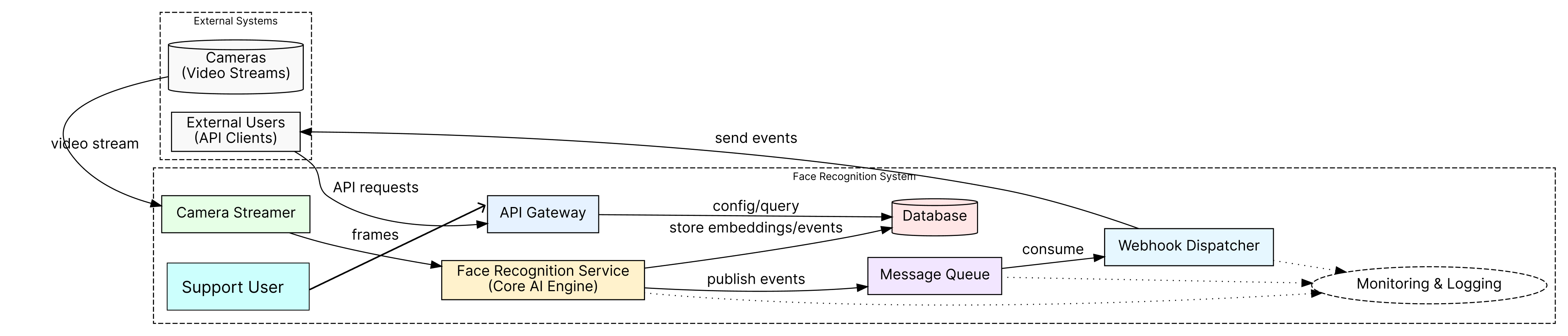 ### Sequence Diagram 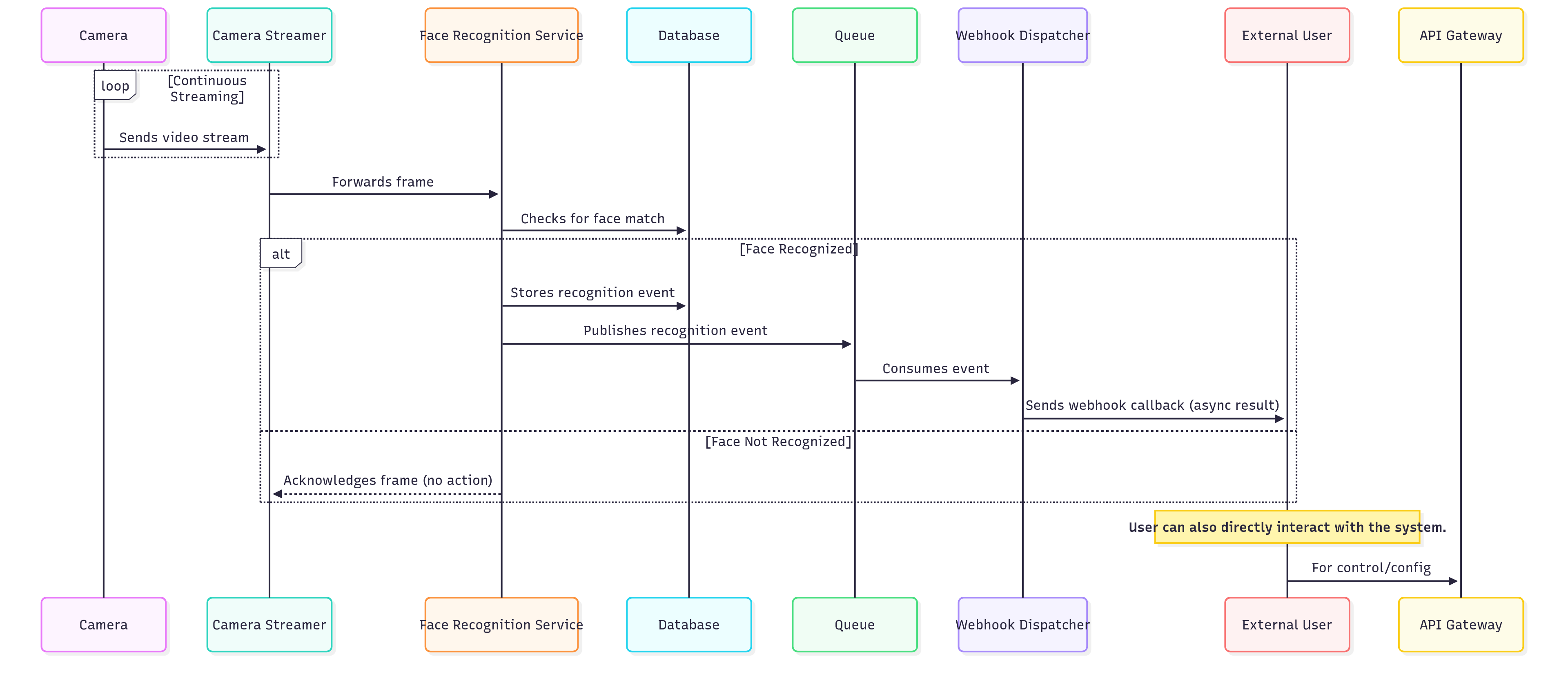 ### ERD 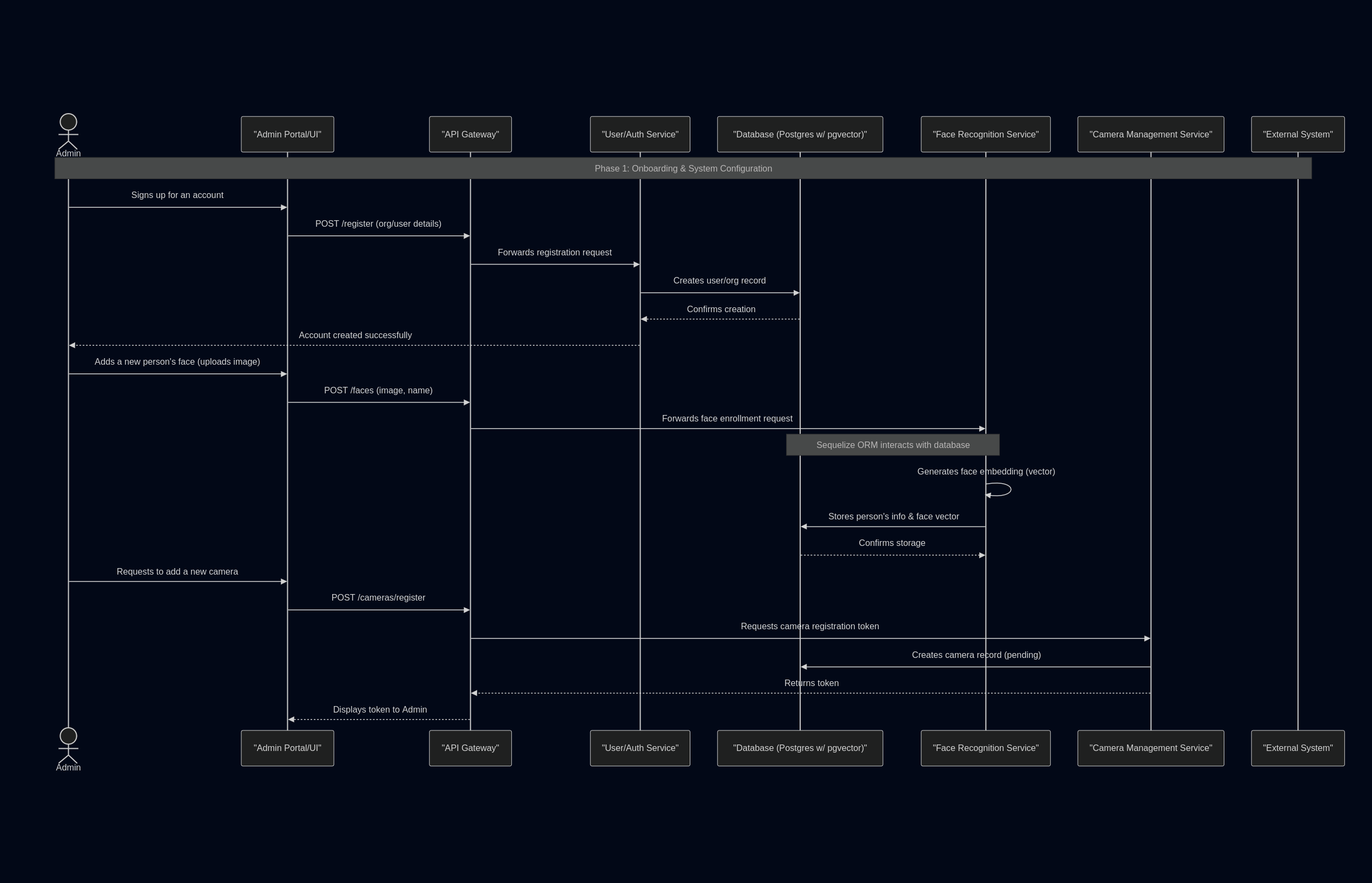 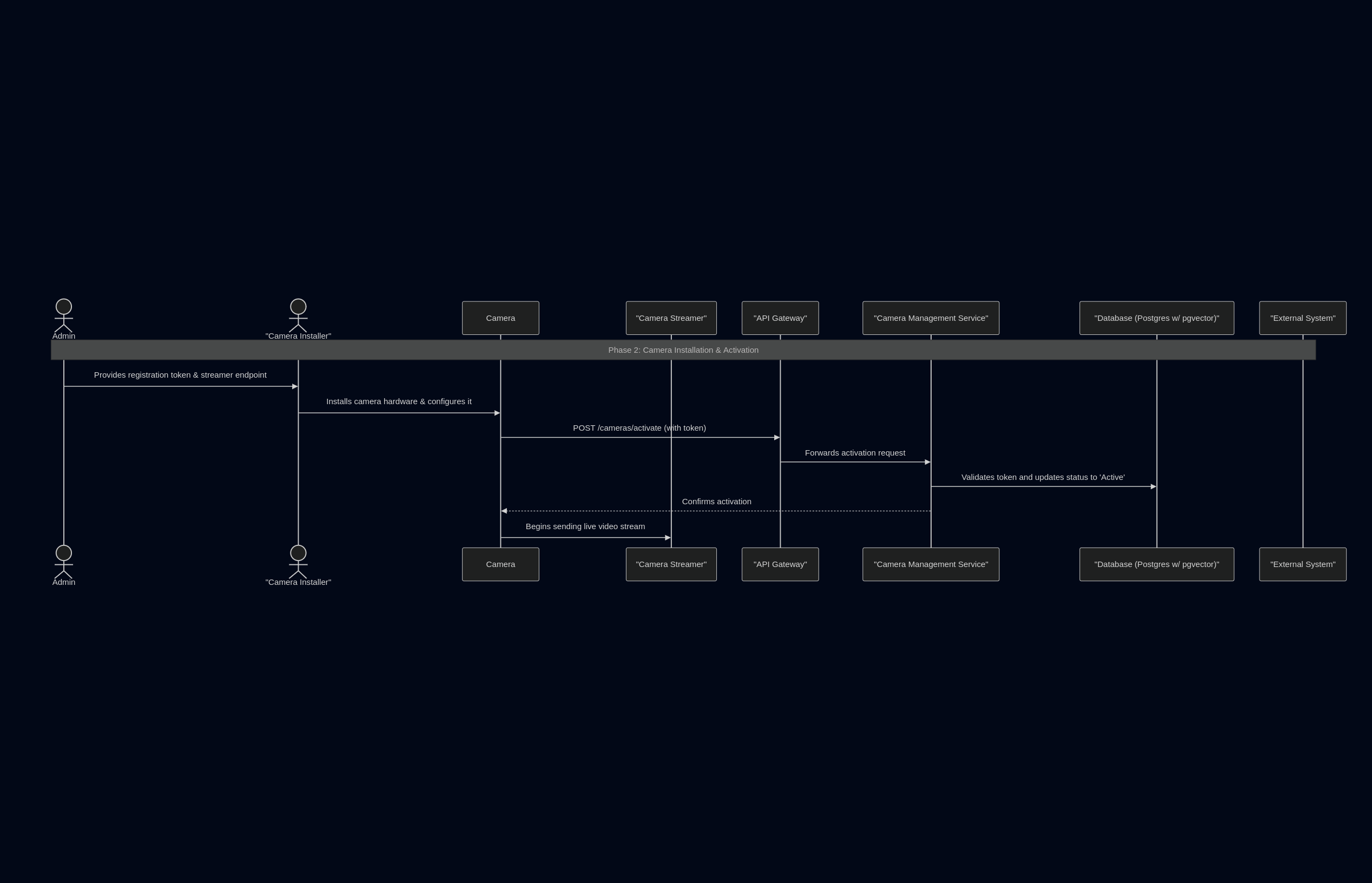 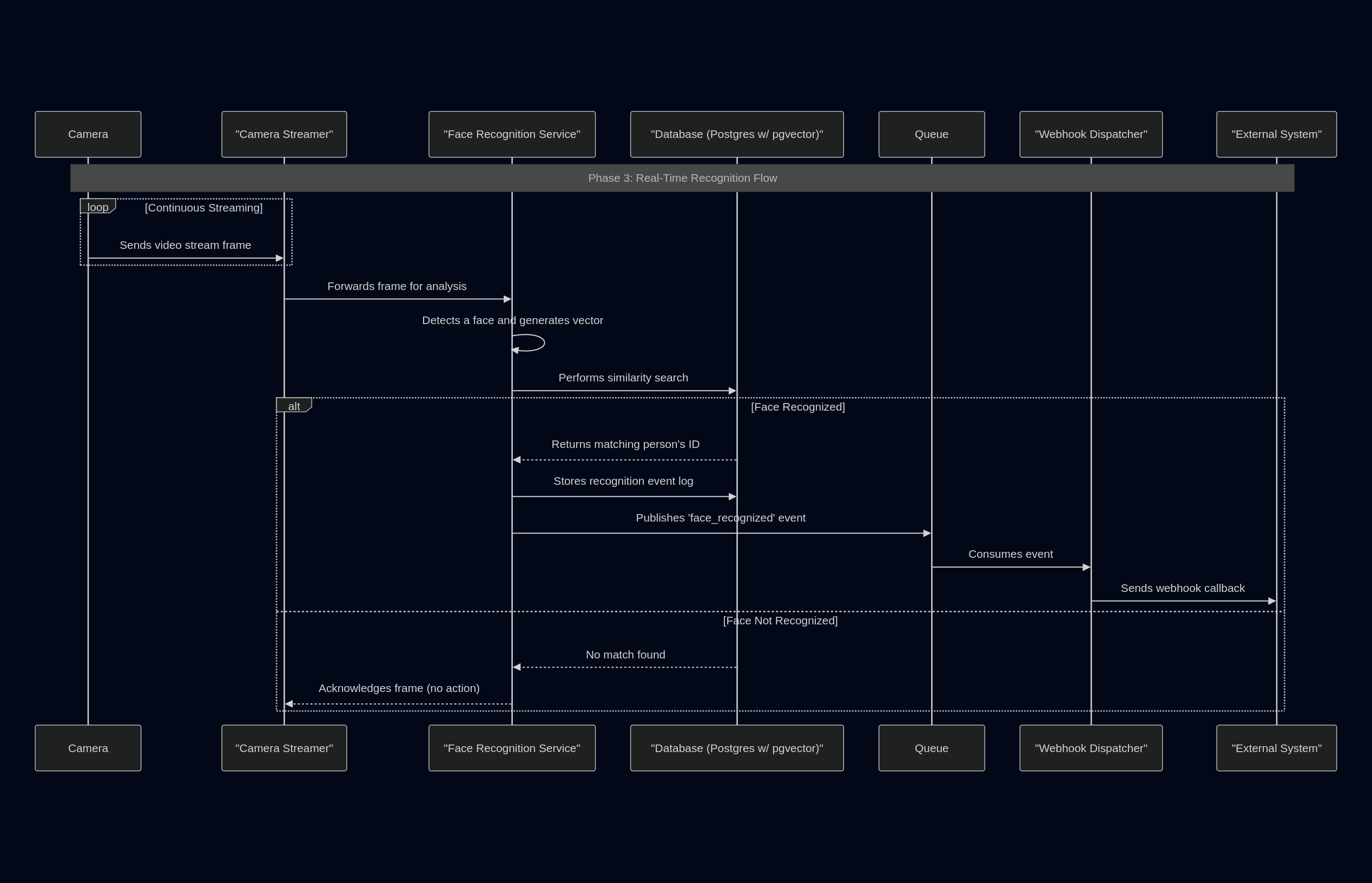 ## Challenges & Learnings Challenge: Handling high frame rates and concurrent streams without latency. Learning: Decoupling services with message queues significantly improved system reliability. Challenge: Ensuring high recognition accuracy under varying lighting and camera quality. Learning: Preprocessing with OpenCV (normalization, alignment) boosted accuracy. ## Future Roadmap Short-term goal: Improve recognition accuracy above 98% and optimize model inference speed. Medium-term goal: Add multi-camera support dashboard and mobile app for real-time alerts. Long-term goal: Open-source the solution for broader adoption with pluggable modules. ## Repository & Live Demo * **GitHub Repository:** [Link to your code repo here] * **Live Demo:** [Link to your live demo or video walkthrough here] (Highly encouraged!) ## Screenshots / Demo Video (Embed screenshots of your working application or a video demo here. A picture is worth a thousand words.) --- **Categories:** #project #ai-hackathon-[year] #category-[your-topic] 🖼 System Diagram Components External Systems Cameras (outside system) → stream video into your system. External Users → interact via API Gateway and receive results via Webhooks. Your System API Gateway Entry point for external users. Handles authentication, throttling, request routing. Camera Streamer Ingests live video feed from external cameras. Converts/normalizes streams (RTSP/RTMP → processing format). Face Recognition Service (Core AI Engine) Processes frames from the camera streamer. Detects and recognizes faces. Generates events (match/no match, alerts). Database Stores user profiles, face embeddings, recognition logs, and camera metadata. Webhook Dispatcher Sends recognition results/events back to external systems in real-time. Message Queue (Recommended Addition) Decouples camera streamer → face recognition → webhook dispatch. Ensures reliability and handles spikes in video frames/events. Monitoring & Logging Collects system logs and metrics for performance monitoring (Grafana, Kibana, etc.). Frontend (FE) Connects to API Gateway for UI interaction **** Real-time face detection and recognition service that captures video from cameras, detects faces, matches them against a database, and logs all events. Image Storage Format Database Table: faces | What's Stored | Column Type | Format | Size | | --------------| ------------|-------------------------------------|------------------| | Photos (JPEG) | BYTEA | Raw binary bites | ~50 KB each | Face Encodings| BYTEA | Pickled NumPy array (128 numbers) | ~9 KB each | Each person has 3 photos + 3 encodings Photos stored as raw JPEG binary (NOT base64) Encodings stored as pickled NumPy arrays (128-dimensional vectors) Face Recognition Process Library Used: face_recognition (built on dlib) How It Works: Upload Phase (via API): Upload Photo → Extract Face → Generate 128 numbers → Store in DB Recognition Phase (real-time): Camera Frame → Detect Face → Generate 128 numbers → Compare with DB → Match Found? → Log Event Matching: Compares 128-number vectors using Euclidean distance Distance < 0.6 = Match ✅Confidence = 1 - distance (e.g., 0.3 distance = 70% confidence) Key Components Camera Service - Captures RTSP video streams Face Detection - Finds faces in frames Face Matcher - Compares faces with database (in-memory cache) Database - Stores faces, encodings, and events API - 15 REST endpoints for management Storage Summary ✅ Images: Raw JPEG bytes in database ✅ Encodings: Pickled 128-number arrays ✅ Recognition: face_recognition library (dlib backend) ✅ Matching: Vector comparison (Euclidean distance) ✅ Performance: In-memory cache, ~99% accuracy Bottom Line: Photos stored as binary, converted to 128 numbers for matching using industry-standard face recognition library! 🎯